“A landmark documentary...delineates how virtuosity becomes identity”
- Debra Cash, NPR/WBUR

1842 Clubs
1842 CLUB IN THE FIVE POINTS
The Five Points, c.1845
Davy Crockett’s supposed autobiography (it was probably ghost written), An Account of Colonel Crockett’s Tour to the North and Down East, offers a lively description of an 1835 dance hall in New York City’s colorful ghetto of poverty, The Five Points -- now situated near the city and state courthouses and One Police Plaza in lower Manhattan. At its southern tip, Manhattan island narrows, and Five Points was almost in the middle, surrounded on three sides by water. The great sailing ships were berthed so close to each other that a sailor (or thief) could hop from one ship to another. Sailors from all over the world spilled out into the surrounding Five Points, seeking liquor, women, music and dancing -- making Five Points the hotbed of dance invention.
…in the midst of that great city we came to a place where all five streets come together; and from this it takes the name of “Five-points.” The buildings are little, old, farm houses and looked like some little country village…. The houses all had cellars; it appeared as if the cellars was jam full of people; and such fiddling and dancing nobody ever saw before in this world. I thought they were the true “heaven-borns.” Black and white, white and black, all of em-snug together, happy as lords and ladies, sometimes sitting in a ring with a jug of liquor between them
Ghetto of poverty: Five Points cellar boarding house, c.1845
When Charles Dickens toured America seven years later in 1842, he also visited NYC’s Five Points. He visited one of the cellar dance clubs, but in order to get there, he had to walk through muck. “Here, too, are lanes and alleys paved with mud knee-deep; underground chambers where they dance and game; the walls bedecked with rough designs of ships, of forts, and flags, and American Eagles out of number.” Dickens ironically christens this Five Points joint “Almacks,” using the name of London’s largest best-known public dancing “assembly” (a kind of membership dance club).
Heyday! The land lad of Almack’s thrives! A buxom fat mulatto woman, with sparkling eyes, whose head is daintily ornamented with a handkerchief of many colors, nor is the landlord much behind her in his finery. How glad he is to see us! What will we please to call for? A dance? It shall be done directly, sir. “A regular breakdown.”...The dance commences. Every gentleman set as long as he likes to the opposite lady, and the opposite lady to him, and all are so long about it that the sport begins to languish….”
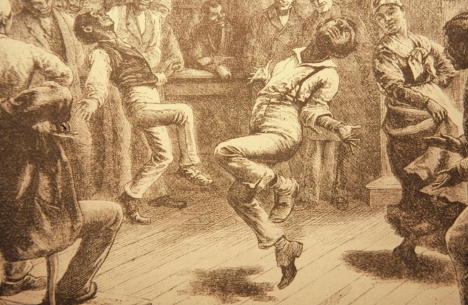
Ecstatic dancers in early cipher, in cellar dance hall, from Charles Dickens’ Travels in America, 1842
Even in 1842 the term “breakdown” was so ubiquitous that could describe a specific dance formation – or dancing in general. “Breakdown” and “break it down, now!” are still yelled out today as a way of shouting encouragement or to describe good dancing. In 1842, the landlord called for a reel (also called a “longways” dance): “Every gentleman set as long as he likes to the opposite lady...” that is, the women line up on one side, the men on the other and they partner each other. However these dancers took so “long” to arrange themselves, then took so “long” to dance, that the “sport begins to languish.”
At this point, a young African-American man jumps onto the floor. Some tap dance historians claim that this young man was William Henry Lane.
Early stylist of American tap and unique club dancer, William Henry Lane, from Minstrel broad sheet, c.1848
Whether he was or not, and despite the fact that there is no hard evidence to support this claim, the very presence of this young man represents larger and more important phenomena: Blacks and whites were freely dancing together despite laws forbidding miscegenation; there were extremely skilled virtuosic young dancers who could do astonishing Five Points’ variations of Irish step dancing, and they “worked” the clubs to heat up the floor. They performed a unique, highly individualized style that used as its foundation some version of Irish step dancing and earned respect and status for their skills. The latest fast-footwork variations are labeled “fast footwork” (NYC clubs), in California there are many variations of the “C-Walk” in 2011, and in New Orleans, there is the “NOLA Bounce.”
In each era, the dancers add spins, rubbery legs, loose ankles and knees, with feet and legs rapidly turning in then turning out and spiced with jumps (“no legs” writes Dickens), which might end with a break down to the floor, since that type of landing is a logical and comfortable finish. The young man at Five Points (William Henry Lane, perhaps) finishes by rebounding and “leaping gloriously on the bar-counter.”
…suddenly the lively hero dashes in to the rescue…the fiddler grins, and goes at it tooth and nail; there is new energy in the tambourine, new laughter in the dances. Single shuffle, double shuffle, cut and cross-cut; snapping his fingers, rolling his eyes, turning in his knees, presenting the back of his legs in front. Spinning about on his toes and heels like nothing but the man’s fingers on the tambourine; dancing with two left legs, two right legs, two wooden legs, two wire legs, two spring legs – all sort of legs and no legs – what is this to him? And in what walk of life, or dance of life, does man ever get such simulating applause as thunders about him,…he finishes by leaping gloriously on the bar-counter, and calling for something to drink,…
Charles Dickens, 1842 edition, American Notes…, pp. 127-28, quoted in Luc Sante, pp, 293-4
A soloist separates from a group, a cipher forms and he displays his virtuosic moves (“does man ever get such simulating applause as thunders about him?”). Today there would be less applause and more whoops of approval or watchers might slap the floor to show respect. But Dickens has described lineage, a family of movement and an eclectic style that echoes what good club dancers effortlessly pull off today -- one-hundred-and-sixty-nine years later.


